

At Longwood, bonds formed between faculty and students have no expiration date. From mentee-to-colleague, student-to-peer, even faculty-to-friend, the strongest of those relationships evolve over time into lasting connections whose impacts are both professional and personal.
Take the story of Dr. Marieke Van Puymbroeck ’94, a therapeutic recreation major, who—in her own words—”wasn’t a great student and, frankly, had no interest in going to graduate school.”
As an undergraduate, Van Puymbroeck found her way to Longwood’s therapeutic recreation department shortly after enrolling and discovered a program she describes as “a small major that was just so nice and cozy.” And what she lacked in a valedictorian-level GPA—at least at the time—she made up for with a passion to help individuals with disabilities.
“Once I found the field, I felt like I found my purpose—that it was to serve and help people with disabilities,” she said. “I just feel such a love and commitment to helping people improve their lives. In this field, you get to do that using activities they enjoy as a means of therapy. It’s the best.”
Van Puymbroeck dove into the profession immediately after graduation and spent several years as a recreational therapist helping patients with disabilities. She was content and fulfilled in the work. She was also unaware that the relationship she forged with Longwood’s faculty would soon inspire her toward a new career—and several more diplomas—that she never saw coming.
In 1997, three years into her career as a recreational therapist, Van Puymbroeck returned to campus to take part in the annual Longwood Therapeutic Recreation Alumni Conference. The event, which the university still hosts today, is designed to bring together alumni from the major for networking, professional development and support.
During the homecoming, Van Puymbroeck reconnected with her former professor and mentor, Dr. Susan Lynch, who met Van Puymbroeck during her senior year. Lynch, remembering the potential she saw in Van Puymbroeck as a student, offered her former pupil some food for thought.
“At the conference, Susan and another faculty member tag-teamed me about going to graduate school,” Van Puymbroeck recalled. “There was some information about grad programs at different schools, and they rigged a contest so I would win some University of Florida swag. Then, after I won all this Florida stuff, they talked me into applying to grad school there.”
That application turned into acceptance to Florida’s master’s program for therapeutic recreation, and by 2004, Van Puymbroeck—the self-proclaimed “not a great student”—had amassed a perfect 4.0 GPA on the way to earning two more degrees and the title of Dr. Van Puymbroeck, Ph.D. of rehabilitation science.
Fast forward to 2025 when Van Puymbroeck was named vice provost and dean of the Graduate School at the University of Tennessee, and her career in higher education has spanned more than two decades. And while that pivot moved her away from her original boots-on-the-ground work as a recreational therapist, it has allowed her to amplify her impact on patients with disabilities by training and advocating for thousands of future therapists—just as Lynch did for her.
“I wanted to multiply the effect of being a good therapist,” Van Puymbroeck said. “I wanted to train people to be good therapists because I saw the benefit of being a great therapist and the impact it could have.”
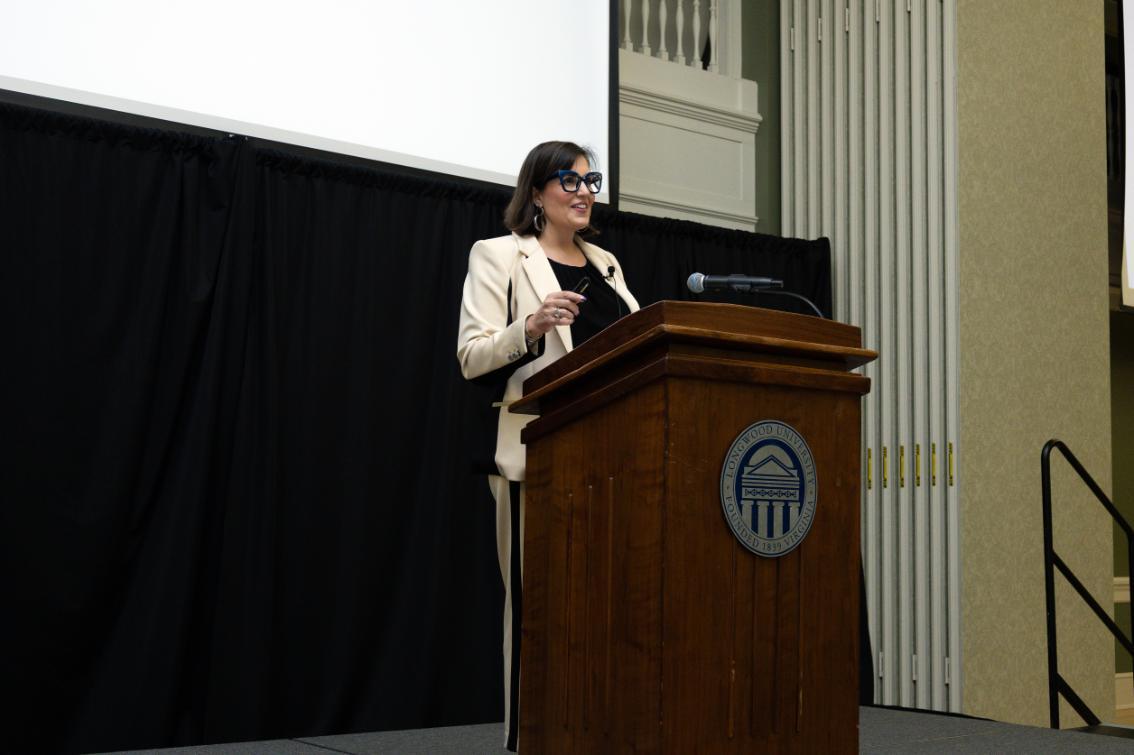
This fall, Van Puymbroeck’s career trajectory came full circle when she returned to campus once again to participate in the Therapeutic Recreation Alumni Conference. Only this time, she was the keynote speaker.
“Susan asked me to come because she’s retiring,” she said. “I said absolutely.”
In her presentation to nearly 100 assembled therapeutic recreation alumni—which she titled “Oh the Things You Can Do with a Recreational Therapy Degree”—Van Puymbroeck laid out her professional journey, starting with her early days as an unsure student to her work as a therapist, graduate school experience and decorated career in academia.
Included was her personal testimony about the far-reaching impact of faculty like Lynch, who will retire at the end of the 2026-27 academic year after 33 years at Longwood.
“If I think about Susan’s impact, I’ve similarly influenced thousands of students,” Van Puymbroeck said. “And I’m just one of the thousands of students Susan had herself, so it really shows the exponential impact good educators can have as mentors and lifelong colleagues.”