

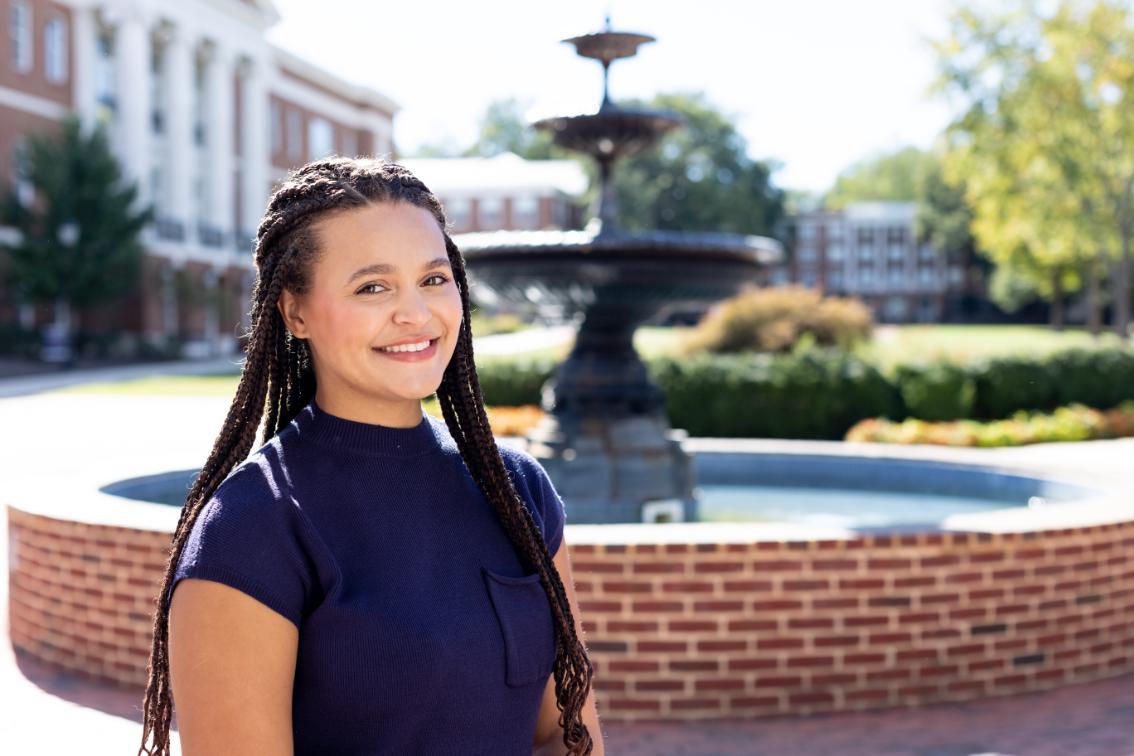
Allanah Smith ’27 was enjoying a late summer day with family and friends on Buggs Island Lake near her home in Boydton, Virginia, when a familiar Longwood name flashed across her phone. Recognizing the caller as Vice President for Student Affairs Cameron Patterson ’10, M.S. ’17, she sensed the call might bring life-changing news—and asked her mom to stop the boat.
Moments later, the Communication Sciences and Disorders major learned she had been named the 2026–27 recipient of the Moton Legacy Scholarship, one of Longwood’s highest honors. Cheers erupted across the boat as the news sank in.
I am a first-generation college student, so every milestone is big for me. Every year of school that I finish, every Dean’s List and every accomplishment is important because I’m the first in my family to do it. This recognition by far surpassed anything that I have accomplished and it made me feel really good.
Allanah Smith ’27
“It was such a special moment because it really solidified my hard work,” Smith recalled. “I am a first-generation college student, so every milestone is big for me. Every year of school that I finish, every Dean’s List and every accomplishment is important because I’m the first in my family to do it. This recognition by far surpassed anything that I have accomplished and it made me feel really good.”
The Moton Legacy Scholarship honors Prince Edward County’s local civil rights history and recognizes students who demonstrate a commitment to equality of educational opportunity. Established in 2014 by Longwood’s Board of Visitors in partnership with the Moton Museum and first awarded in 2015, the scholarship covers tuition and fees for the recipient’s senior year.
For Smith, the honor reflects not only her academic achievements but also a growing appreciation for the history of educational access and the responsibility to advocate for others.
Despite growing up about an hour and a half from Farmville, Smith said she knew little about the Moton story, Barbara Johns or the local civil rights movement before coming to Longwood. Her introduction to Johns, the teenage civil rights activist who helped lead a 1951 student strike against segregated schools in Prince Edward County, began close to home: her residence hall. Smith lived in Johns Hall during her freshman and sophomore years.
“I didn’t know about Barbara Johns until I actually lived in that building and walked past her biography every day to get to my room,” she said.
The story took on new meaning during her sophomore year, when she visited the Moton Museum for the first time as part of her sociology of education class. Learning about the student-led struggle for educational equality reshaped how she viewed her own education and the people whose sacrifices helped make it possible.
[The Moton story] really changed my outlook on my education. I had this new sense of how I see everything—including the people who came before me and their part in getting me to where I am today. It’s powerful.
Allanah Smith ’27
“That really changed my outlook on my education,” Smith said. “I had this new sense of how I see everything—including the people who came before me and their part in getting me to where I am today. It’s powerful.”
She also recognized something of herself in Johns’ determination to challenge injustice.
Smith attended a private high school where she was the only student with a mixed-race background. The experience taught her to speak up for herself and advocate for greater inclusion.
“I was the only biracial girl there, and that took a lot of advocating for myself, a lot of standing up for what I believe is right and really changing the way some people think so that it’s more inclusive of everyone,” she said. “I see myself a lot in Barbara Johns because she saw something that wasn’t right.”
That commitment to advocacy also informs Smith’s aspirations for her future. In her scholarship application essay, she wrote about navigating college as a first-generation student and her goal of becoming an audiologist. She hopes to be the first in her family to graduate from college and, eventually, the first to earn a doctoral degree.
“I wrote about how I would take that opportunity to create spaces for people who have not always felt included or have not always felt welcome and create a sense of belonging in the community that I serve,” she said.
Patterson, who serves as senior partner for strategic initiatives at the Moton Museum, said Smith stood out for her work ethic, campus involvement and desire to make a difference.
“Through her academic achievements and active involvement on campus, she exemplifies the legacy of Barbara Johns and the importance of standing up to be a voice for others,” he said. “Moton’s partnership with Longwood creates a meaningful opportunity to advance the university’s mission of developing citizen leaders. Allanah’s personal experiences give her a unique perspective. We are excited to see how she continues to serve and make a positive impact in her community after graduation.”
Smith has put those leadership principles into practice throughout her time at Longwood. She currently serves as vice president of the Student Government Association and sits on its Student Finance Committee, which allocates funding to student organizations. She is also the spirit coordinator for Mortar Board, an active member of the American Sign Language (ASL) Club and historian of Tri-Alpha, a national honor society recognizing the academic achievements of first-generation college students.
Smith arrived at Longwood intending to become a speech-language pathologist, but her first ASL class introduced her to a different path. She plans to attend graduate school after graduating in May and pursue a Doctor of Audiology degree, with the goal of becoming a pediatric audiologist and eventually opening her own practice.
For Smith, her future career is about more than helping people hear. It is an opportunity to build relationships, serve families and support a community she has come to love and appreciate. She will carry with her the lessons of Johns and the students who challenged an unjust system, along with a determination to help others feel seen, heard and included.
“The Deaf culture and ASL is such a beautiful thing, you don’t know until you immerse yourself in that culture,” she said. “I want to help and serve that community and work with them every day.”